
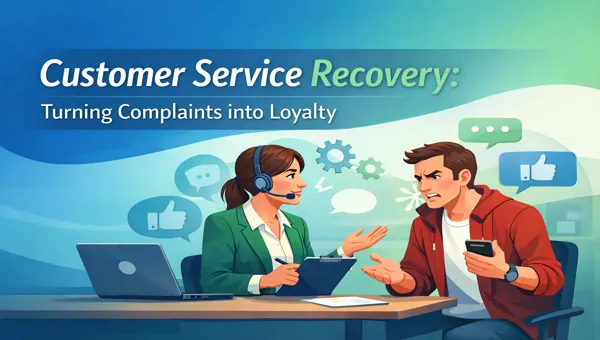
Last month, a client told us about a customer complaint that almost broke their small tourism business. A family had booked a weekend getaway package, everything went wrong – weather, accommodation mix-up, activity cancellation – and they were furious.
The Complaint That Changed Everything
The kind of furious that ends up on Google reviews and Facebook rants.
But here's the twist: that same family became their biggest advocates. They've since booked three more trips, referred four other families, and regularly share positive posts about the business on social media.
What changed? The way the complaint was handled.
This isn't a feel-good story about going above and beyond (though that happened too).
It's about understanding that customer service recovery isn't damage control – it's a business opportunity that most Canadian small businesses completely miss.
Why Customer Service Recovery Matters More Than Prevention
Don't get us wrong – preventing problems is important. But here's what we've learned from working with small businesses across Canada: customers don't expect perfection. They expect problems to be handled well when they happen.
The recovery paradox: Customers who experience a problem that gets resolved well often become more loyal than customers who never had a problem at all.
Why this happens:
- They see how you handle pressure
- They experience your values in action
- They feel heard and valued as individuals
- They have a story to tell about your business
The Canadian small business advantage: Unlike big corporations with rigid policies and multiple departments, you can make decisions quickly and personally. Use that.
Developing effective customer service recovery skills requires HR expertise and strategic planning.
The Real Cost of Poor Recovery
Most small business owners think about complaints in terms of immediate damage – the refund, the lost sale, the negative review. But the real cost is much bigger.
What poor recovery actually costs:
- Lost lifetime value: That customer will never buy again
- Negative word-of-mouth: They'll tell an average of 9-15 people
- Online reputation damage: Reviews stay forever
- Employee morale: Your team feels helpless and frustrated
- Your own stress: Bad reviews keep you up at night
The multiplier effect: In small communities and niche markets, one badly handled complaint can damage relationships with multiple potential customers who know each other.
Creating positive customer service experiences starts with fundamental skills training. Explore essential workplace skills for culture building that every team member should master.
The 5-Step Recovery Framework That Works
After analyzing hundreds of customer service situations with Canadian small businesses, we've identified a framework that consistently turns complaints into loyalty.
Step 1: Listen First, Defend Never
What most businesses do wrong: They start explaining why the problem happened or defending their policies before they fully understand what the customer experienced.
What works: Let them tell the whole story without interrupting. Ask clarifying questions. Acknowledge their feelings.
The magic phrase: "Help me understand what happened from your perspective."
Why this works: People need to feel heard before they can hear you. Defensive responses escalate emotions; listening de-escalates them.
Step 2: Take Ownership (Even When It's Not Your Fault)
The ownership mindset: You're not taking blame for everything – you're taking responsibility for making it right.
What this sounds like:
- "I can see how frustrating that must have been"
- "That's not the experience we want anyone to have"
- "Let me see what I can do to fix this"
What it doesn't sound like:
- "That's not our policy"
- "The supplier/weather/system was the problem"
- "There's nothing I can do"
The Canadian context: We're polite people. Use that. Genuine empathy resonates more here than corporate scripts.
Step 3: Solve the Immediate Problem
Focus on what you can control: Don't get stuck explaining what you can't fix. Focus on what you can do right now.
The solution hierarchy:
- Fix the original problem (if possible)
- Provide equivalent value (different solution, same outcome)
- Compensate appropriately (refund, credit, extras)
- Prevent future occurrence (process changes, better communication)
Speed matters: The faster you solve the immediate problem, the less time emotions have to escalate.
Step 4: Go One Step Beyond
This is where good recovery becomes great recovery: Do something they didn't ask for but that shows you value the relationship.
Examples that work:
- Follow up a week later to make sure they're satisfied
- Send a handwritten note with their refund
- Offer a discount on their next purchase
- Share their feedback with your team and tell them how you're improving
The key: It doesn't have to be expensive – it has to be personal and unexpected.
Step 5: Learn and Improve
Turn every complaint into business intelligence: What can this teach you about your processes, communication, or customer expectations?
The improvement questions:
- How can we prevent this specific problem?
- What would have made this customer's experience better?
- Are other customers experiencing similar issues?
- What training does our team need?
Individual growth drives collective service improvement. Invest in personal development courses for team culture enhancement to see measurable customer service improvements.
Real Recovery Stories from Canadian Small Businesses
The Restaurant Mix-Up
Problem: Wedding rehearsal dinner reservation got lost, party of 20 showed up to no available tables.
Recovery: Manager immediately called sister restaurant, arranged transportation, covered the meal cost, and sent champagne to their table.
Result: The couple books their anniversary dinner there every year and refers all their catering needs.
The Equipment Failure
Problem: Rental equipment failed during a corporate event, causing delays and frustration.
Recovery: On-site technician within 30 minutes, backup equipment provided free, 50% refund, and priority booking for future events.
Result: Company became their largest corporate client and testimonial reference.
The Weather Cancellation
Problem: Outdoor adventure tour cancelled due to weather, family vacation plans ruined.
Recovery: Full refund plus credit for future booking, helped arrange alternative activities, followed up with local restaurant recommendations.
Result: Family rebooked for the following year and brought three other families.
The Psychology Behind Effective Recovery
Why the framework works: It addresses the emotional journey customers go through when things go wrong.
The emotional stages:
- Surprise/Shock: "This isn't what I expected"
- Frustration/Anger: "This is unacceptable"
- Disappointment: "I trusted you and you let me down"
- Hope: "Maybe they can fix this"
- Relief/Satisfaction: "They made it right"
- Loyalty: "They really care about their customers"
Your job: Guide them through stages 4-6 as quickly and smoothly as possible.
Training Your Team for Recovery Success
The biggest mistake: Assuming your team knows how to handle complaints naturally. They don't. It's a skill that needs to be learned and practiced.
Essential training components:
- Active listening techniques – How to really hear what customers are saying
- De-escalation strategies – How to calm angry customers
- Solution-focused thinking – How to focus on fixes, not problems
- Empathy development – How to connect with frustrated customers
- Authority levels – What they can offer without asking permission
Role-playing scenarios: Practice with real situations your business faces. The more they practice, the more confident they'll be when it matters.
When Recovery Isn't Possible
Reality check: Not every complaint can be turned into loyalty. Some customers are unreasonable, some problems are unfixable, and some relationships aren't worth saving.
How to recognize when to walk away:
- Demands are unreasonable or impossible
- Customer becomes abusive to your team
- Cost of resolution exceeds customer lifetime value
- Customer has a pattern of complaints and demands
How to end the relationship professionally:
- Acknowledge their concerns
- Explain what you can and can't do
- Offer a fair resolution
- Wish them well and suggest alternatives
The Tools That Make Recovery Easier
Customer service recovery isn't just about attitude – it's about having systems that support good recovery:
Communication Tools
- Scripts for common situations (not rigid, but helpful starting points)
- Escalation procedures (who to call when things get complicated)
- Follow-up systems (how and when to check back)
Decision-Making Authority
- Clear guidelines on what front-line staff can offer
- Quick approval processes for bigger solutions
- Manager backup when staff need support
Documentation Systems
- Complaint tracking to identify patterns
- Resolution records to learn what works
- Customer history to provide context
Building a Recovery-Ready Culture
The mindset shift: Stop seeing complaints as problems and start seeing them as opportunities to demonstrate your values.
What this looks like:
- Team meetings that discuss recovery successes, not just problems
- Training that builds confidence, not fear
- Policies that empower staff to solve problems
- Recognition for great recovery efforts
The Canadian advantage: We're naturally apologetic and helpful. Channel that into systematic recovery processes.
Measuring Recovery Success
Track the metrics that matter:
- Resolution time – How quickly problems get solved
- Customer satisfaction – Post-resolution surveys
- Repeat business – Do recovered customers come back?
- Referrals – Do they recommend you to others?
- Online reviews – Are negative reviews becoming positive ones?
The ultimate measure: Are customers telling positive stories about how you handle problems?
Ready to Turn Complaints Into Opportunities?
Customer service recovery isn't about being perfect – it's about being human, responsive, and solution-focused when things go wrong.
The businesses that excel at recovery:
- Listen before they speak
- Take ownership without making excuses
- Solve problems quickly and completely
- Go beyond what's expected
- Learn from every situation
The businesses that struggle:
- Get defensive when criticized
- Hide behind policies and procedures
- Focus on why problems happened instead of how to fix them
- Do the minimum required
- Repeat the same mistakes
Your customer service recovery skills directly impact:
- Customer retention and loyalty
- Word-of-mouth marketing
- Online reputation
- Team confidence
- Business growth
Ready to train your team in customer service recovery that builds loyalty?
Our Customer Service course covers:
- Active listening and empathy techniques
- De-escalation strategies for angry customers
- Solution-focused problem solving
- Recovery frameworks that work
- Building customer loyalty through service
Customer service recovery is just the beginning - effective leaders must develop the skills to act on customer insights. Learn more about essential leadership skills every manager needs.
Call (780) 933-0182 or email
Building stronger Canadian businesses, one satisfied customer at a time.
